Dogs · Problem-solver
Puppy Biting: What Stops It, and What Makes It Worse
The things owners do between weeks 8 and 16 that quietly turn nipping into a real problem — and the three interventions that actually work.
Our picks
- West Paw Toppl (Small) — West Paw
- Rocco & Roxie Stain & Odor Eliminator — Rocco & Roxie
If you’ve just brought home an eight-week puppy, you already know. The cute little mouth that charmed you at pickup has been trying to dismantle your hands, your sleeves, and the skin around your ankles since the moment you closed the car door. You read three conflicting guides on the flight home. Now the puppy is sitting in your lap with your thumb in its teeth, and you are wondering whether you have made a serious mistake.
You have not. But the next six weeks matter more than most first-time owners realize, and the advice you follow from here will decide whether this phase ends at sixteen weeks or stretches miserably into adolescence.
This is what the field evidence — from veterinary behaviorists, working trainers, and thousands of post-mortem Reddit threads on r/puppy101 — actually says.
The thing nobody tells you
Puppy biting is not aggression. It is not dominance. It is not something your puppy is doing to you. Between eight and sixteen weeks, a puppy is doing three things at the same time: teething, learning what its mouth feels like to other living creatures, and testing which behaviors produce interesting reactions.
That last one is the part most owners mishandle. The single most common mistake that runs through trainer forums and new-owner subreddits is accidentally rewarding the biting. Puppies bite, owner squeals and jerks hand away, puppy gets a huge dopamine reaction from the motion, puppy learns that hands produce the best game in the house. Repeat forty times a day for three weeks and you have taught your puppy that biting is how you initiate fun.
The second most common mistake is shouting, tapping on the nose, or scruffing. These work for about four minutes, then backfire. The puppy either becomes reactive to hand movement near its face (a problem you will pay for at the vet for the next fourteen years) or learns that humans are unpredictable and escalates instead of calming down.
What actually works
Three interventions, in order of importance.
1. Give the mouth somewhere else to go
Puppies teethe for roughly six to eight weeks. They will chew something during that time. Your only decision is whether it is your couch or a designated chew.
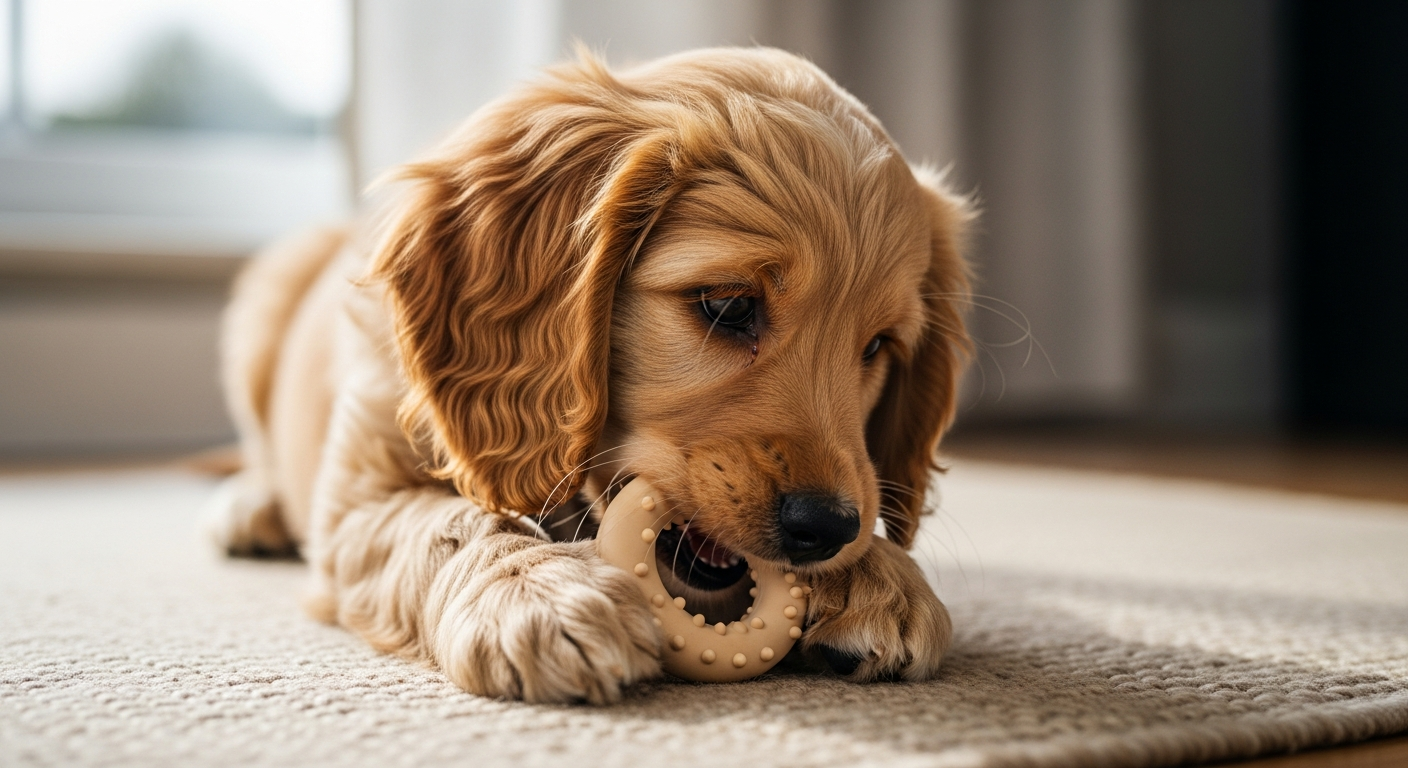
The minimum viable kit: one food-motivated chew (a Puppy KONG stuffed with soaked kibble, frozen), one passive chew (a Benebone or edible teething ring), and one soft plush to be destroyed at leisure. Rotate them. Put two away for three days, bring them back out, and the “new” toy problem solves itself without another purchase.
Freezing matters. Cold numbs inflamed gums in a way room-temperature rubber doesn’t, and a frozen stuffed KONG is the single most effective piece of equipment for the witching hour — the 30-minute window between 6 and 8 PM when puppies turn into small piranhas.
2. End the game, don’t escalate it
When the puppy bites skin: stand up, walk to the other side of a baby gate or into a bathroom, close the door, count to thirty, come back calmly. No scolding, no eye contact, no announcement. You are not punishing the puppy. You are removing the thing the puppy was biting for — you.
This works because puppies are social. Removal of attention is the only consequence that registers on a reliable neurological level before about sixteen weeks. Thirty seconds is enough. Longer does nothing useful.
After three to four days of consistent enforcement, most puppies visibly recalibrate. After two weeks, the skin-biting typically drops by 70 to 90 percent. This is the outcome positive-reinforcement trainers and certified behaviorists (CPDT-KA, KPA-CTP) report in the published literature and in case-study writeups.
3. Sleep. More than you think.
An eight-week puppy needs eighteen to twenty hours of sleep a day. A twelve-week puppy needs sixteen to eighteen. The majority of new owners underfeed their puppy on sleep in the first month, and an overtired puppy is a biting machine. If biting intensity spikes in the evening with no apparent cause, the puppy is not hungry, not bored, not naughty — it is exhausted and miscalibrated.
A covered crate in a quiet room for two hours in the mid-afternoon will do more to fix evening biting than any chew toy, any training class, and any online course you could buy.
What makes it worse
In rough order of how badly owners regret them:
- Yelping like another puppy. A popular piece of advice on older training blogs; it teaches some puppies to back off and teaches others — herding breeds in particular — that you are a prey animal making injured-rabbit sounds. Skip it.
- Rough-housing with hands. Wrestling a puppy with your hands as the toy teaches the puppy that hands are toys. Use a tug rope or flirt pole if the puppy needs contact play.
- Punishment at the face. Tapping the nose, holding the muzzle shut, pinning the puppy. All of these produce one of two outcomes: a puppy that becomes hand-shy (bad), or a puppy that has learned to warn you less before snapping (worse).
- Waiting it out. Some breeds slow-bake out of biting. Most do not. A puppy allowed to bite at twelve weeks is a puppy still biting at twenty weeks, and adolescent mouth-pressure is a different league of painful.
The gear that pays for itself
Only four things. Everything else is optional.
A stuffed puppy KONG, frozen, is the single highest-ROI purchase for weeks eight to sixteen. The West Paw Toppl is the upgrade pick — it’s easier for a puppy to actually lick clean, which means it holds attention for 25-30 minutes instead of frustrating the puppy into quitting. A Benebone covers the passive-chew slot. A pack of N-Bone teething rings covers the two or three bad nights. And an enzyme cleaner — Rocco & Roxie is the one that consistently tops trainer-recommendation lists — erases the scent cues that tell your puppy to chew the same spot on the rug again tomorrow.
When to worry
Almost never. But two specific signals are worth flagging to a vet or a certified behaviorist:
- Biting that includes a freeze and a hard stare first. That is not puppy mouth-play. It is a resource-guarding or fear response, and the earlier it is addressed the better.
- Biting that does not de-escalate when the puppy is removed from the trigger. Most puppies, separated from whatever set them off, reset inside a minute. A puppy that stays hyperaroused for ten or fifteen minutes after being removed needs professional eyes on it.
Everything else — the ankle-nipping, the sleeve-tearing, the sudden 7 PM chaos — is normal. It passes. The owners who get through it cleanly are the ones who stop taking it personally, give the mouth somewhere else to go, and protect the sleep.
The puppy is not trying to hurt you. It is eight weeks old and its whole body is a nerve ending looking for feedback. Give it better feedback than your hand.
Products mentioned
The gear, with prices
West Paw
West Paw Toppl (Small)
Typical price
$18
The chew we'd buy first if we were starting over. Wider, shallower bowl than a KONG, which means a puppy can actually get its tongue in — and that is the difference between a KONG stuffed with peanut butter that frustrates the dog into giving up and one that keeps a puppy working for 30 quiet minutes. Zogoflex rubber is dishwasher-safe, US-made, and genuinely durable on puppy teeth. The medium nests inside the large to create a two-stage puzzle; worth knowing.
Find on Amazon →Affiliate link · we earn a commission at no cost to you
Rocco & Roxie
Rocco & Roxie Stain & Odor Eliminator
Typical price
$20
The enzyme cleaner that actually removes the protein signal telling your puppy 'chew here next time.' Not a biting product on paper, but owners who skip this step quietly prolong the biting phase.
Find on Amazon →Affiliate link · we earn a commission at no cost to you
KONG
Puppy KONG Classic (Small)
Typical price
$11
The chew that every trainer still recommends for a reason — it lasts, it freezes well, and a puppy figures out how to work it out eventually. Its weakness is shape: the deep narrow cavity is hard for small tongues to clean. Best used alongside a Toppl rather than as a standalone.
Find on Amazon →Affiliate link · we earn a commission at no cost to you
Benebone
Benebone Puppy 2-Pack
Typical price
$18
Softer nylon tuned for puppy teeth. The curved shape is genuinely easier for small mouths to grip than a straight bone. Pair with the KONG so the puppy has both a food-motivated chew and a passive one.
Find on Amazon →Affiliate link · we earn a commission at no cost to you
N-Bone
N-Bone Puppy Teething Ring
Typical price
$5
Edible chicken-based teething ring for the two-to-three worst teething days. Not a daily chew — they're consumed quickly and high in calories. Keep a pack for evenings when nothing else is working.
Find on Amazon →Affiliate link · we earn a commission at no cost to you
Pawcrit participates in the Amazon Services LLC Associates Program. When you click a product link and make a purchase, we may earn a small commission at no cost to you. Our editorial rankings are not influenced by affiliate relationships — read our full disclosure.